

Physical description of Asiatic Golden Cats
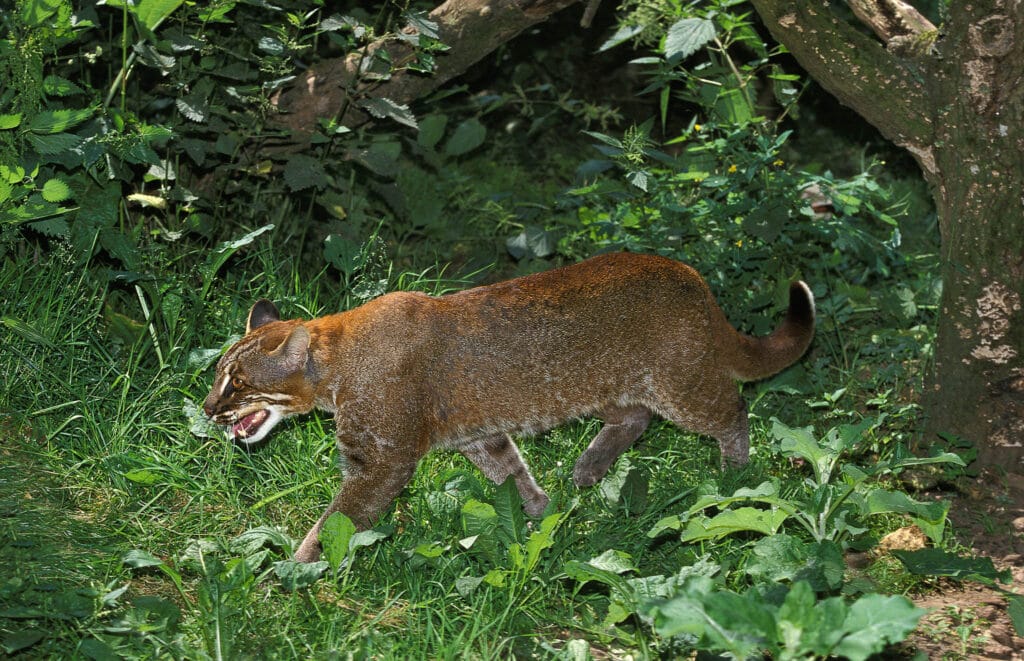
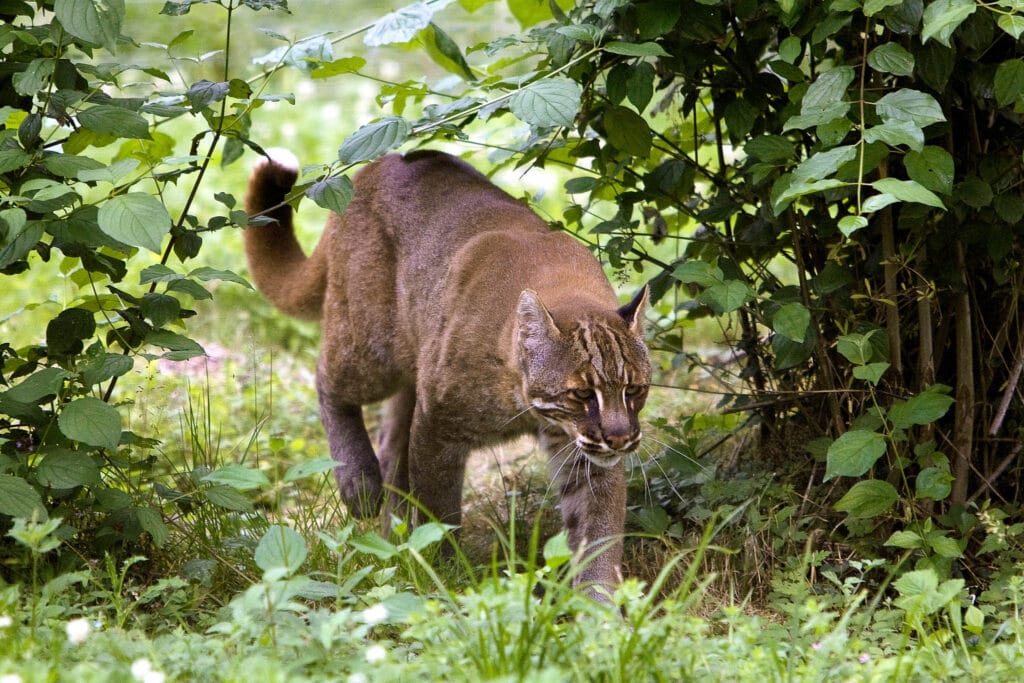
Asiatic golden cats are medium-sized. They have relatively long tails, which, along with their long legs, permit comfortable tree climbing. Albeit, most live on the ground.
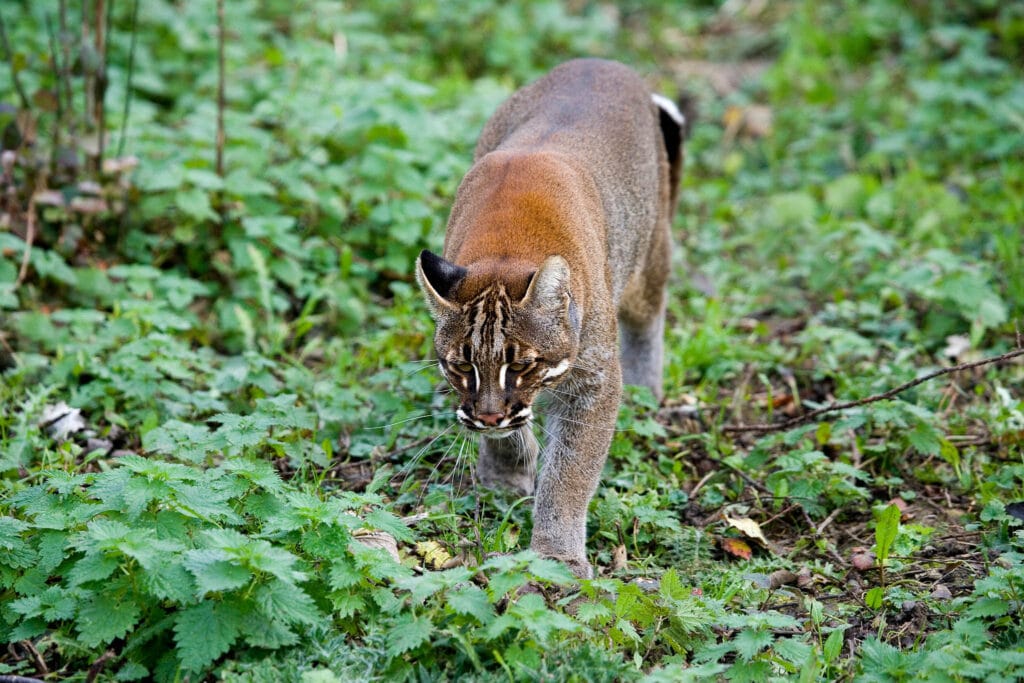
Despite the name, golden cats’ fur is not necessarily golden-colored, but can be black, brown, grey, or even reddish like foxes. The underside of their body and tail is white. They have black and white lines on the forehead and cheeks, and occasionally spots on the chest and front shoulders.
Distribution and habitat of Asiatic Golden Cats
Asiatic Golden Cats are found in Southern Asia, from the east of the Indian subcontinent throughout the Malay Peninsula and northwards into southern China. The habitat variation provides an extensive area for this small cat, however immense human populations in this region put pressure on the species and have limited its range.
The Asiatic golden cat lives mostly in forests. They are found in all types of forest: tropical and subtropical, dry forest and rain forest, and evergreen and deciduous forest. They do not have a particular preference for forest type but they certainly opt for forest coverage rather than open grassland.
The area throughout their range contains high mountain extremes, and they have been known to live up to 3500 m above sea level.
Asiatic Golden Cat behavior
Radio tracking of individuals in a Thai wildlife park revealed some interesting and useful information about the Asiatic golden cat. They are most active during the twilight hours rather than being nocturnal, as was once thought.
Fairly numerous but difficult to detect in the forest, it was reasonable to assume they were overlooked due to being nocturnal. Also active during the day, it appears that we didn’t observe them simply because the Southeast Asian jungles are too dense.
One can assume that akin with other cats, they use scent markings for a variety of purposes, such as territorial communication, but it is uncertain how the Asiatic golden cat communicates for social bonding.
What do Asiatic Golden Cats eat?
Asiatic golden cats eat small rodents, small snakes, and even small deer. In certain parts of their range, they have been observed to hunt larger animals such as {wild pigs}and {sambar deer}.
Mating and Parental care of Asiatic Golden Cats
Being forest dwellers, Asiatic golden cats are seldom studied in the wild. Due to their timidity and habitat preferences, little of their behavior has been observed scientifically. Thus, the majority of our information has been acquired from captive individuals.
Females give birth in secluded areas, in tree hollows or similar areas, for protection of the kittens. Litters normally have one to three kittens. It takes six months before they are weaned and approximately a year to reach independence. Not dissimilar from other cat species, the fathers do not bear responsibility for their offspring.
Males have shown aggression towards females in captivity, and it is thought that they will only form a union in the wild for mating. The known size and extent of territories are imprecise, although in a Thai wildlife sanctuary, radio-collared individuals showed a sizable overlap in their ranges.
Who preys on Asiatic Golden Cats
To the best of our knowledge, only humans prey on Asiatic golden cats.
How long do Asiatic Golden Cats live?
In the wild, the cats’ lifespan can be up to 20 years, however this is speculation.
Asiatic Golden Cats and their ecosystem
As an apex predator, they play an important role in maintaining the balance of populations in forests.
Impact of Asiatic Golden Cats on the human economy
Unfortunately for Asiatic golden cats, their bones are used for spurious medicinal purposes. Their fur is traded, and hair used as a talisman or amulet.
Trading in parts of Asiatic golden cats is illegal although it still occurs.
The Asiatic golden cat is known to prey on livestock, which causes human-cat conflict where the populations are in close contact.
Conservation status and human impact on Asiatic Golden Cats
On the IUCN list, Asiatic golden cats are endangered. Habitat loss, both from deforestation for agriculture and logging is a major cause of the cat’s problems.
Poaching for meat and body parts is also a major issue. One enduring myth is that the hair provides protection in the forest and is a safeguard against tigers. It would be equally ridiculous to suggest that allowing the extinction of tigers would, therefore, prevent the poaching of Asiatic golden cats.
Whilst education is a more suitable option, it is difficult to convey across diverse cultures.


