

Physical description of Jungle Cats
As one of the larger Felis species, the jungle cat can be up to 120 cm long and 40 cm tall. There is a difference in sizes across the range. In areas with fewer predators, jungle cats tend to be larger than those found in areas such as India, where Leopards, Tigers and Dholes out-compete them.
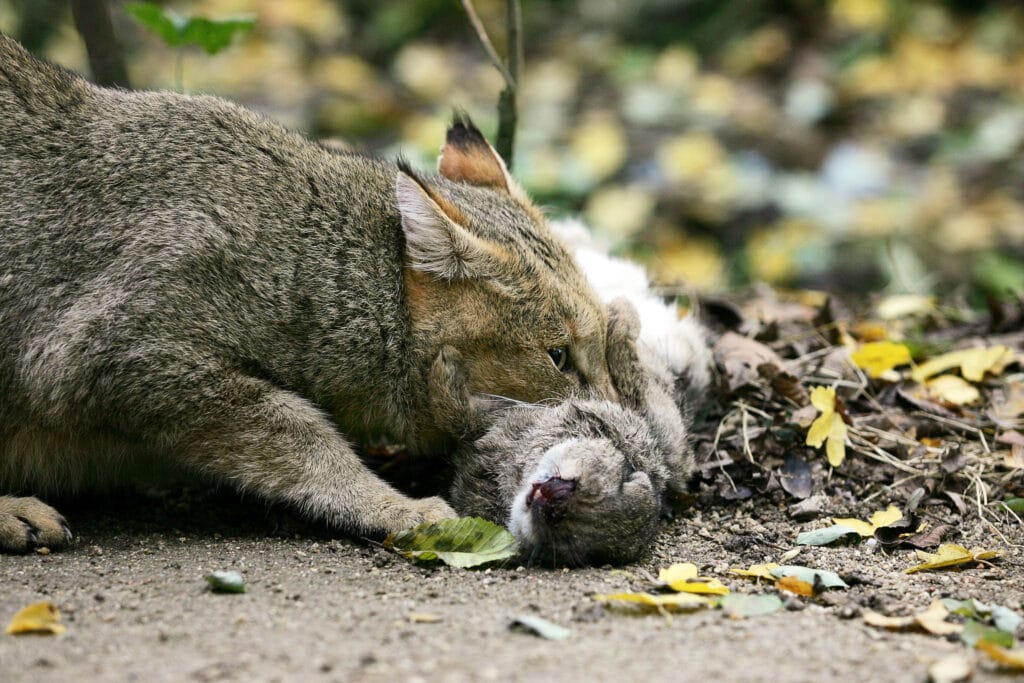
Jungle cat kittens are born with stripes and spots, though these disappear as they grow up. An adult is generally reddish to light brown and sometimes a bit greyer. The stripes and spots of youth remain only on the legs and the tail. In India, some black individuals have also been spotted. Faces also have some markings and are a bit paler than the rest of the fur. Often, the eyes have a white outline and a darker area below.
It should be noted that there are significant differences within the species across its range, and there are ten different subspecies.

Distribution and habitat of Jungle Cats
The Jungle Cat ranges from Egypt across Asia and is even found in the southern reaches of European Russia. It lives from the jungles of Southeast Asia to the deserts of Central Asia and, despite its name, is often found in areas with no jungle at all.
Their preferred habitat is somewhere with water. Rivers and their surroundings might be the most obvious places to meet them, but their preference to live and hunt near water means they also can be found in and around oases in the desert as well as in the dense jungle. However, the jungle cat prefers less dense vegetation, such as woodland or dry deciduous forests and even agricultural lands.

Jungle Cat behavior
Despite the parental care being more noticeable than in other cat species, jungle cats are still classed as solitary. We only see them as pairs when mating, or in the family group of a mother with her young.
Like a lot of life in the jungle, these cats are nocturnal. That does not necessarily mean they are inactive during the day. Jungle cats are sometimes out and about in daylight hours, but more often than not, they hide in the dense jungle.
One interesting behavior that makes them stand out compared to other cat species is their willingness to get wet. Jungle cats are good fishers and do so from the water rather than from the edge, like some other cat species.
Vocalization is common among jungle cats within the family group. Scent marking is also commonly done with both urine and cheek rubbing.
What do Jungle Cats eat?
The preferred prey of the jungle cat is small. As mentioned it is a good fisher but, just like other cats, also eats rodents and other small mammals as well as reptiles and birds.
While cats are carnivorous, the jungle cat, like its American jungle cousins, has been known to eat fruit on occasion. However, this is a minor part of the diet, and small mammals are by and large the preference.
Mating and Parental care of Jungle Cats
The reproductive cycle of the jungle cat isn’t too surprising. The one noticeable difference to other cats is that the father does appear to provide some sort of care for kittens.
While in most cat species, it is the mother that rears kittens alone, it does seem that the male jungle cat patrols its territory with more zeal when kittens are around to prevent other males from killing the kittens.
There are about three kittens per litter, sometimes more. Mothers care for the kittens for nine months, the first six weeks nursing them, then bringing them back kills, and from about three months on, they are fully weaned, though they stay with the mother another 5 to 6 months to learn to hunt.
While most cats leave the mother at sexual maturity, the jungle cat leaves earlier and lives independently for a while before reaching full maturity.

Who are the Jungle Cat Predators?
Jungle cats also hunt livestock, and that makes them a target for farmers. In their native habitat, the jungle, they don’t have any other predators unless they live in an area with leopards or tigers.
Smaller predators like dholes or jackals will also prey on the jungle cat from time to time. Their habitats do overlap a bit but in general they stay away from each other. The dogs are more likely to prey on a small or young cat.
How long do Jungle Cats live?
It is thought that the jungle cat lives for about 12 years in the wild.
Jungle Cats and their ecosystem
It is hard to say what effect the jungle cat has on its environment other than keeping the smaller animals in check.
Impact of Jungle Cats on the human economy
As the jungle cat is not hunted for its pelt, it offers little or no direct economic benefit to humans.
The jungle cat is known to prey on small livestock in areas of high human populations. This is obviously annoying for the local farmers and, in a lot of places, has a significant economic effect on poor jungle communities.

Conservation status and human impact on Jungle Cats
Hunting and persecution for livestock deaths is a threat to the jungle cat. However, habitat destruction is, as ever, the biggest threat to this species.
The IUCN lists the jungle cat as “Least Concern,” but the living cats are illegally traded as pets and hunted for killing livestock, and due to the destruction of their habitat, they are declining in number.
Other important information about Jungle Cats
Felis chaus nilotica (Nile Region)
Felis chaus chaus (Southern Russia)
Felis chaus furax (Middle East)
Felis chaus oxiana (Central Asia (Northern Afghanistan))
Felis chaus prateri (Thar desert)
Felis chaus affinis (Himalayas)
Felis chaus kutas (India)
Felis chaus valballala (India)
Felis chaus kelaarti (Sri Lanka)
Felis chaus fulvidina (Southeast Asia)


