

Physical description of Mountain Lions
The mountain lion is a relatively big cat with body lengths of up to one and a half meters in males. The female is about 10 % smaller. The tail adds almost another meter to some of the bigger animals.
It is not as bulky as other cats this size, being more closely related to the cheetah than to the lion. However, the legs resemble the latter a bit more, being quite strong and muscular compared to the cheetah’s lithe limbs made for running.
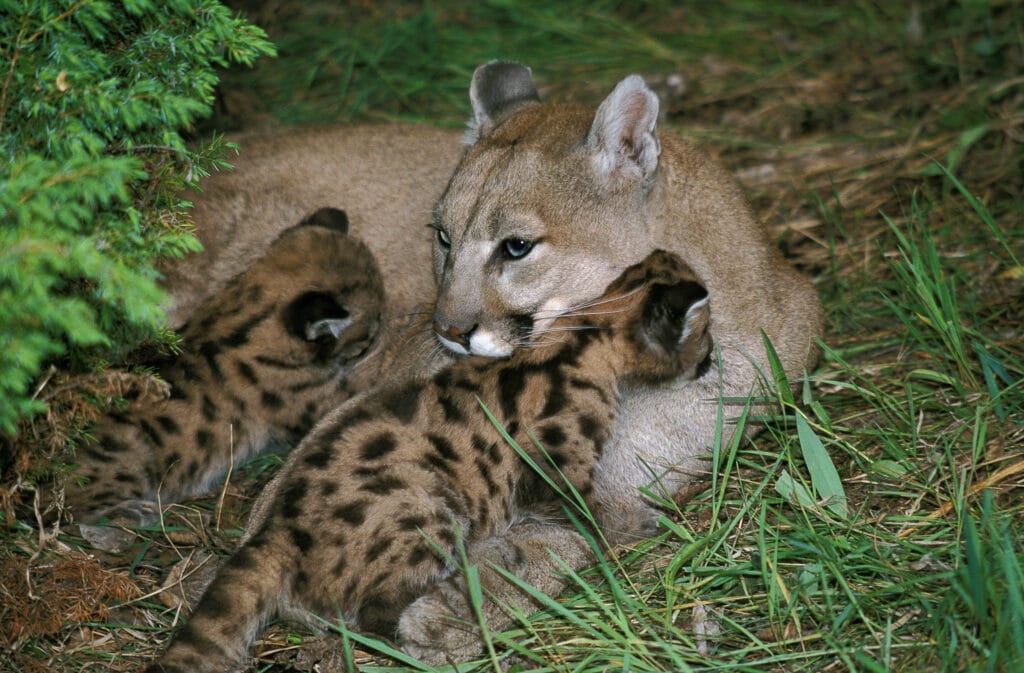
Its short fur is rather rough and varies from light golden brown to a more muddy grey color. On its belly, it is a bit lighter and often has a white chest. The pink nose is distinctive, but the rest of the facial markings are relatively subtle.
The broad, flat head marks the mountain lion as easily recognizable among cats.

Distribution and habitat of Mountain Lions
While the range of Pumas used to be much more widespread, today their population is more limited. They still range across most of the Americas, but their populations are much more restricted, especially in the USA.
The eastern US now only has a limited population in Florida. Numbers are higher in the west, and sometimes pumas are to be found in suburban areas such as in California.
Further south, they are found in most habitats, but the most visible are those of Patagonia. The cougar does live in the tropical jungle as well but is seen much more rarely, given the dense cover.
The cougar lives in a multitude of habitats, from arid grasslands to dense jungles and from tropical to mountain forests. It uses anything from thick brush to caves for cover and shelter
Best National Parks to see Mountain Lions
If you are visiting National Parks like Banff, Yellowstone you might get a chance to see Mountain Lions. Also the State Parks of souther California have a population that is more visible than in some other places.
Mountain Lion behaviour
Other than mothers with their young, mountain lions are solitary cats. Yes, most cats are. The only time males and females tend to spend time together, other than random meetings in overlapping territories, is when they are mating. This can last up to a week but is generally just a couple of days.
Being such large and predatory animals, they have quite a range. Depending on the amount of prey available, mountain lions need up to 300 sq km per animal. The range of males is quite a bit more than the females that share his territory.
Sometimes, young males are found together like cheetahs, but unlike their close cousins, this does not last into adulthood.
Mountain lions are communicative, especially between the young and their mother. Depending on the circumstances, these cats have a large vocabulary of growls and purrs. However, the young seem to whistle when calling to their mother.
Like other cats, scent is also an important communication tool, used for marking territory and letting the opposite sex know you are interested.

What do Mountain Lions eat?
This should be no surprise to anybody: Mountain lions, like most cats, are strict carnivores. They will eat any prey they can find but tend to look for larger kills when possible. That means any bigger deer like elk in the North and Guanaco in the southern portion of their range. Moose and caribou are also on the menu, as are livestock animals. However, they hunt livestock a lot less than they are given credit for, as there is a risk in being around human habitation.
A mountain lion needs more than one large animal a week and so supplements its diet with smaller animals like rabbits, raccoons, opossums, squirrels, and at times even birds and fish when they can get hold of them. As one animal the size of an elk can last so long, mountain lions often hide them, covering them with brush and returning on subsequent nights to feed.
Mating and Parental care of Mountain Lions
Separate mountain lion territories are important. The very young are kept in dens in protected areas by the mother. These areas need to have enough prey nearby to support a nursing mother and her brood.
Females keep separate territories and generally don’t start breeding until such territories have been properly established. Males often have territories that overlap with female mountain lions, and males sometimes pose a danger to cubs.
Mating can occur at any time but generally in the winter months, leading to birth three months later. Females reproduce typically every two years and give birth to 3 or 4 cubs. Cubs are already active within the first two weeks and are weaned after about six weeks.
Like most cats, they stay with their mothers a lot longer as they need to learn to hunt. Generally, families are together for just over a year, but it can be longer. It takes 2 to 3 years before cats will establish a breeding territory.
Who preys on Mountain Lions
The biggest threat to a mountain lion is man. However, their small stature does leave them vulnerable to wolves or bears who are desperate for a meal. Even larger mountain lions will sometimes see a smaller one as potential prey.
How long do Mountain Lions live?
The expected lifespan of a mountain lion is about 20 years.
Licensed from Shutterstock
Mountain Lions and their ecosystem
In a lot of the areas inhabited by mountain lions, populations of other top predators have been decimated by human interference. That means that now they are an important method of control for the grazing population.

Impact of Mountain Lions on the human economy
Unfortunately, nowadays mountain lions are still hunted. They are persecuted by farmers, sometimes for good reason but often not, and also hunted for sport in the US.
Despite their position in US culture as dangerous predators of hikers, there is, on average, only one fatal attack every five years. Given the circumstances of most attacks, it is thought that the mountain lion mistakes humans for prey, and quite often, it is a case of uninformed hikers letting younger and smaller members of their party separate from the group at prime hunting time (evening).
In the vast majority of encounters, mountain lions retreat instantly. Knowing the behavior of mountain lions significantly decreases the risks.

Conservation status and human impact on Mountain Lions
The Wisconsin subspecies is considered to be extinct, though it is still listed as endangered. The Florida and Costa Rican subspecies are believed to still be with us, though both are severely endangered.


