Panthera onca

Quick Facts

Status: Near Threatened

Young: have from 1-4 cubs, usually 2

Weight: 70-140 kg

Diet: Carnivore

Physical description of Jaguars

The jaguar is colored like a leopard. With a beige/yellow colored fur. The underside is a bit lighter colored, and of course, they have rosettes like their cousin. The difference: the jaguar’s rosettes are more prominent, with a spot in the center. Similarly, there are melanistic versions of the jaguar. The black panther can be either a leopard or a jaguar.

As a member of the Panthera genus, it should be evident that jaguars are a “big cat.” About one and a half meters long and just under a meter tall, they are the biggest and most powerful of the New World cats. Their jaw is, in fact, the most powerful of all cats. This makes their face a bit tougher and heavier than their similar-looking cousin. They are a bit bigger than the leopard and much more powerful.

The size and weight of jaguars vary according to their range. Central American cats are a bit smaller than the Brazilian ones. Those in Southern Brazil can weigh up to 100 kg.
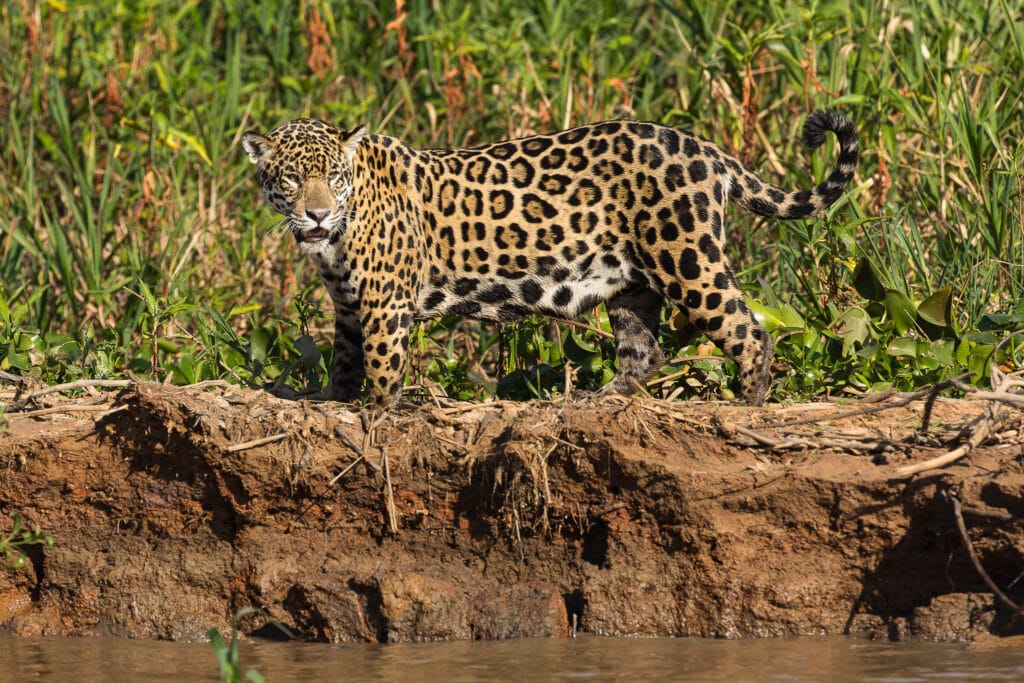
A majestic Jaguar (Panthera onca) poised on the bank of the Cuiaba River, Brazil.
Licensed from Shutterstock
A majestic Jaguar (Panthera onca) poised on the bank of the Cuiaba River, Brazil.

Distribution and habitat of Jaguars

Jaguars are found all the way from Argentina to the US. Though there are jaguars in both countries, they are rare at the limits of their range. There are more significant numbers in the tropical rainforests of Central America and the Amazon, as well as in the wetlands of the Pantanal in Southern Brazil.

The jaguar’s preferred habitat is jungle and dense forest. However, they are also found in more open areas, such as the Pantanal wetlands. For the vast majority of their range, they are found in wet areas, and caimans are a favored food source. However, when jaguars are present in the US, in Arizona, and further south in Mexico, they are found in drier regions. They still tend to live and hunt around the rivers, but caimans are not a primary food source in this region.

In 2024, jaguars are increasing in numbers in New Mexico and Arizona. Camera traps are showing an increase, but the building of the infamous Border Wall will definitely impact these cross-border populations.

The mountains of the Andes and Central America don’t have many jaguars. In some areas like Costa Rica, where the treeline is relatively high, and the prey is sufficient, they can be found at higher altitudes.

A majestic female jaguar (Panthera onca) lounges on a tree limb above the tranquil waters of the Pantanal. As an apex predator, she does not need to worry about a thing.
Licensed from Shutterstock
A majestic female jaguar (Panthera onca) lounges on a tree limb above the tranquil waters of the Pantanal. As an apex predator, she does not need to worry about a thing.

Jaguar behavior

Jaguars can be seen regularly during the day. They are, like other cats, most likely to be seen at dusk and dawn. Nearly all wildlife is most active at these times. If you are a predator, it definitely helps to go out when your prey is most active

Like other cats living in extremely hot regions, they take cover from the heat of the midday sun, hiding away in the undergrowth of the jungle. Also, like other cats, they are solitary. You are unlikely to see two together unless it is a mother and her cubs. Or maybe during mating season.

Continuing the theme, jaguars copy other cats when it comes to hunting: they are ambush hunters. They are extremely powerful and good swimmers. A spectacular way of hunting that is often seen in the Pantanal is to climb a tree overhanging the wetlands. From there, when a tasty-looking caiman is in range, they simply drop out of the tree and land directly on their prey. The attack is quick and sudden, and the caiman would have no idea what hit it. A powerful bite to the back of the neck kills the caiman almost instantly.

Jaguars communicate through scat markings and sound.

A jaguar (Panthera onca) gracefully wading the waters of the Cuiabá River in the Pantanal, Brazil. One of the world's largest wetlands, the Pantanal offers exceptional opportunities to witness jaguars and other wildlife. Jaguars, excellent swimmers, frequently hunt in the water.
Licensed from Shutterstock
A jaguar (Panthera onca) gracefully wading the waters of the Cuiabá River in the Pantanal, Brazil. One of the world’s largest wetlands, the Pantanal offers exceptional opportunities to witness jaguars and other wildlife. Jaguars, excellent swimmers, frequently hunt in the water.

What do Jaguars eat?

Anything meaty is a good meal for a jaguar. The majority of their prey are mid-size mammals or reptiles. Caimans are somewhat common in wetland areas, and in thick jungle creatures like deer are good. Capybaras are also a decent meal for a jaguar, but other rodents are somewhat small and not really worth the effort.

Jaguars (Panthera onca), like their feline counterparts, meticulously groom their sleek fur.
Licensed from Shutterstock
Jaguars (Panthera onca), like their feline counterparts, meticulously groom their sleek fur.

Mating and Parental care of Jaguars

Females give birth to a litter of 2 or 3 cubs after approximately 3-4 months gestation. Depending on the region, this can happen at any time of the year. I have read that birth is often during the wet season, allowing for more abundant prey, but also that births occur more frequently from March to June, which in the Pantanal is the end of the wet season and well into the dry. Of course, the seasons vary wildly over the range of jaguars who exist from Paraguay to Mexico and beyond.

It takes over a year before jaguars become fully mature, with females maturing a bit more quickly, as is seen in other large cats. From about the age of six months, the cubs join their mother on the hunt, but they take a back seat as it can be up to two years before they have learned enough to hunt consistently on their own.

Like all cat species jaguar cubs (Panthera onca) like to play. This one is concentrating on its mother's tail to improve his reflexes.
CC License, image by Bernard DuPont
Like all cat species jaguar cubs (Panthera onca) like to play. This one is concentrating on its mother’s tail to improve his reflexes.

Who preys on Jaguars?

Humans are the only predators of jaguars. Hunting for their beautiful fur is, unfortunately, still a thing.

Captured in the heart of the Pantanal, two majestic Jaguar brothers (Panthera onca) survey their domain from the river's edge.
Licensed from Shutterstock
Captured in the heart of the Pantanal, two majestic Jaguar brothers (Panthera onca) survey their domain from the river’s edge.

How long do Jaguars live?

Jaguars can live for ten years or more. Of course, this is dependent on getting through the first challenging year of life. In some regions where habitat is limited, the second year can also be quite dangerous. There is risk in establishing a new territory, from the cats who are already there and from wandering through ranchers’ land while trying to find a suitable habitat to establish as one’s own.

The Jaguar (Panthera onca) is often seen on the river banks in the Pantanal. It is here that it exits the dense jungle cover to hunt.
CC License, image by Bernard DuPont
The Jaguar (Panthera onca) is often seen on the river banks in the Pantanal. It is here that it exits the dense jungle cover to hunt.

Impact of Jaguars on the human economy

Recently, in places like the Pantanal, the jaguar has become a driver of ecotourism. This helps significantly to bring in outside money. In some ranching areas, the potential of ecotourism has helped convince farmers who lose livestock of the value of jaguars as co-inhabitants rather than as competitors on their ranches. These cases are still few and far between. There is plenty of room for improvement in the jaguar’s range. The Pantanal’s success in creating ecotourism based around the jaguar has yet to be reproduced elsewhere.

The negative effect of jaguars on the human economy only occurs when they attack livestock. This is not common, but it does occur, and often in regions where farmers are not living lives of luxury. Naturally, this causes strife between the ranchers and the jaguars.

Almost all cat species can be melanistic. Here you can see that the Jaguar (Panthera Onca) still has its spots. It is the fur that is between the spots that has become dark and obscures them. Most commonly we see melanism in Jaguars and Leopards.
Licensed from Shutterstock
Almost all cat species can be melanistic. Here you can see that the Jaguar (Panthera Onca) still has its spots. It is the fur that is between the spots that has become dark and obscures them. Most commonly we see melanism in Jaguars and Leopards.

Conservation status and human impact on Jaguars

The IUCN status is near threatened. The biggest problem facing jaguars is habitat loss. However, being shot by ranchers is a significant issue in areas with cattle. This is just a symptom of loss of habitat.

In the dense jungle Jaguars (Panthera onca) are hard to find. The forest cover or jungle can get quite dark but fortunately for the photographer their was light falling on this jaguars face.
CC License, image by Gregory “Slobirdr” Smith
In the dense jungle Jaguars (Panthera onca) are hard to find. The forest cover or jungle can get quite dark but fortunately for the photographer their was light falling on this jaguars face.

If your friends are animals lovers, share this page with them

Jaguar in French, German, Spanish …

Latin Name

Panthera onca

French Names

Jaguar

German Names

Jaguar

Spanish Names

Jaguar, Otorongo, Tigre, Tigre Americano, Tigre Real, Tigre Mariposo, Yaguar, Yaguareté

Swahili Names

Jagwa

Popular Blog Posts

More animal Information

The Black-footed cat (Felis nigripes), one of the smallest members of the cat family, boasts the title of the most successful hunter among all felines. Native to Southern Africa.

Black-footed Cat

The smallest of the cats and the most successful hunter, the Black-footed cat (Felis nigripes) is known from its fame in David Attenborough’s BBC TV series.

Within the diverse array of domestic cat breeds (Felis catus), the Persian stands out for its lavish fur.

Domestic Cat

Yes this is a site for wild animals but the domestic cat is very closely related to other cats and is sometimes found in the wild. Be sure you can distinguish feral and wildcats.

Andean cat (Leopardus jacobita) in Cochahuasi Animal Sanctuary near Cusco.

Andean Mountain Cat

The Andean Mountain Cat (Leopardus jacobitus), one of the world’s most elusive felines, thrives in the high altitudes of the Andes. Its distinctive silver-grey fur and bushy tail highlight the unique biodiversity and the challenges of conservation in South America’s rug…

Thriving in its natural winter habitat amid the snow-covered terrain of Torres del Paine, Chile, the pair of Pumas (Puma concolor) gracefully enjoy the soft glow of the setting sun.

Mountain Lion

The Mountain Lion is the most widespread of the cats in the Americas. Also known as the Puma or Cougar, it ranges from Patagonia to Canada and is most often seen in the mountains.

The Snow Leopard (Panthera uncia) may be more prevalent than previously assumed, primarily because it resides at altitudes that are inhospitable to humans. Its remarkable adaptation to the snow-clad mountainous terrain allows it to navigate and thrive in these rugged landscapes effortlessly, where human presence is minimal. This elusive nature contributes to its mystique and the misconception regarding its numbers.

Snow Leopard

One of the most elusive of the cats, the snow leopard is found mostly on the Tibetan plateau. Improvements in infrastructure in its habitat makes the cat more accessible than ever and the need to protect it even more urgent.

Sand cat (Felis margarita) shows how they blend in with the sand.

Sand Cat

Little is known about the sand cat. It lives in places across the Sahara and middle east. One of the best places to see the sand cat in the wild is Western Sahara where a week in the desert should produce multiple sightings. Otherwise it is hard to find.

Subscribe To Our Newsletter

Join my mailing list to keep up to date with wildlife news.

You have Successfully Subscribed!

Pin It on Pinterest

Share This
Cookie Consent with Real Cookie Banner